Case reception:
One morning at my clinic, I received a phone call from the patient’s father. He narrated:
“My son had visited his sister’s home, 200 km away from his hometown. While in the bathroom, he suddenly developed a severe headache and became unconscious.”
The patient was immediately shifted to a hospital, where he regained consciousness about half an hour later, before any treatment was initiated. Being an old patient of mine, he expressed his wish to consult me. Approximately 90 minutes later, he arrived at my clinic.
Clinical presentation:
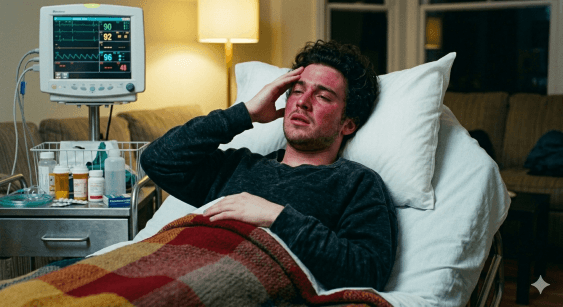
The patient entered the clinic supported by two attendants, staggering and semi‑conscious, holding his head with his hand.
Appearance: Red face, semi‑conscious, staggering gait
Aggravation: Marked aggravation from motion
Physical signs: Feet cold to touch, head hot
He was instructed to lie on the examination table. Belladonna immediately came to mind, and I administered Belladonna 200. After 30 minutes, I inquired about his headache—there was no relief. A second dose was given.
About 15 minutes later, his father asked where the patient could vomit. I directed him to the wash basin but observed that there was no vomiting—only an ineffectual desire to vomit. This symptom shifted the focus of remedy selection.
Remedy Selection:
Base of selection:
The prescription was guided by the theory of complete symptoms, which integrates location, sensation, modality, and concomitant features:
Location: Liver (hepatic origin of headache)
Sensation: Bursting pain felt in the head, originating from hepatic disturbance
Modality: Worse from heat, motion, and light
Concomitant: Ineffectual urging for vomiting
Thus, the complete symptom picture pointed decisively to Nux Vomica.
Prognosis and Outcome:
The prognosis was favorable. Within three days of repeated doses of Nux Vomica 200, the patient became fully conscious, with no aggravation from motion or light.
A CT scan performed on the 10th day after full recovery revealed no abnormalities.
Especial note:
This case highlights the strength of homeopathy:
Treatment was initiated without investigation, guided purely by symptomatology.
The patient presented in a severe state—unconscious, with bursting headache—yet recovered successfully through individualized homeopathic prescription.
It demonstrates that homeopathy can act even on a single, well‑chosen symptom, provided it is characteristic and complete.
Homoeopathy, through its symptomatic approach, proves superior to nosologically diagnosis. This case is evidence that careful observation and remedy selection based on complete symptoms can restore health even in acute, seemingly pathological conditions.