
An overview
It is a common but mistaken belief that homoeopathy acts only slowly and gradually and cannot be relied upon in emergencies. My clinical experience has consistently disproved this notion. Homoeopathic remedies, when selected with precision, often act with remarkable speed—even in acute and critical situations. It has been my fortune to encounter many such acute emergencies where homoeopathy proved effective. Homeopathy can be just as effective as allopathy in treating certain acute emergencies.Case: 1
Case Description:
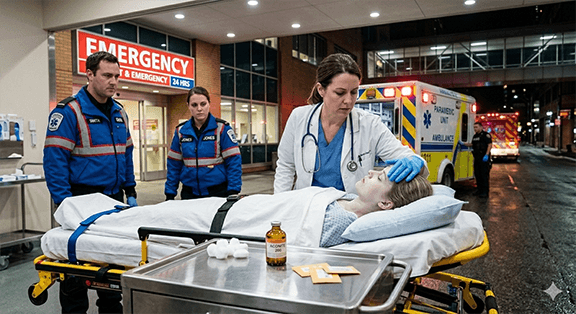
A 19-year-old female presented with an intense fever resembling the clinical picture of Aconitum napellus, though not entirely characteristic. She was prescribed Aconite 200. After two to three doses, the patient developed complete unconsciousness accompanied by generalized coldness of the body, most notably in the feet. When brought to my clinic, she was entirely unconscious, supported by her two sisters who held her tightly to prevent her from collapsing. On arrival, I instructed her sisters to place her on the patient table for immediate attention.
Short case taking:
No subjective symptoms were present except history, because patient was completely unconscious. few objective symptoms were recorded.
1. General coldness, head was slightly warm.
2. Patient was completely unresponsive.
3. Feet were cold as if ice.
4. SpO2 - 98%
5. Pulse 60/min
6. Blood pressure low.
Quick prescription: Camphor - 1M Single dose, (Medicine had been prescribed basis on the symptoms of general coldness with unconsciousness)
Outcome:
The patient became responsive within an hour. I asked her, “What is your name?” and she replied. I then asked, “Where are you?” and she answered, “In the clinic.” Finally, I asked, “Who am I?” and she responded, “Doctor.” Based on these answers, I was assured that she was conscious.
It was puzzling for me, however, when she visited my clinic the next evening. She did not remember any of the questions I had asked. She told me, “Doctor, I became conscious at 2 a.m., when I woke up after sleep.”
Case: 2
The patient was a 34‑year‑old female with a known tendency to develop headaches. On one occasion, she experienced a headache after a morning of fasting, which resulted from a domestic conflict with her husband. In an attempt to relieve the headache, she took an allopathic tablet. Shortly thereafter, she developed a severe reaction characterized by shock: her body became icy cold, her voice trembled, and she was barely able to articulate a few words. this was the clinical presentation of the case.
Short case taking:
1. Inarticulate speech
2. Icy coldness of the patient
3. patient was in semi-conscious state.
Quick prescription: Camphor - 1M (Single dose)
Outcome:
Clinical Course:
- 15 minutes post‑administration: The patient regained partial ability to speak. When asked how she was feeling, she replied, “I am not well.” Despite her complaint, it was observed that her speech had returned.
- 40 minutes post‑administration: Her feet began to warm gradually, indicating improvement in peripheral circulation.
- 2–3 hours post‑administration: The patient reported feeling completely fine, with full recovery from the acute episode.
Clinical Note:
In both of the acute emergencies described above, the medicine was administered based on the presenting symptoms of general coldness with unconsciousness. The underlying cause was not considered essential; rather, the focus was on the symptomatic state. When such symptoms persist, the medicine acts reliably.
Camphor remains one of the most important remedies in the hands of a skilled physician for managing acute emergencies of this nature. Its prompt administration can restore vitality and reverse critical states when coldness and collapse dominate the clinical picture.