
THE ARTISTIC PRESCRIBER
Homoeopathy: An Art and a Science
Homoeopathy is both an art and a science. Unfortunately, most Homoeopathic colleges focus only on the scientific aspect of this great medical discipline. The artistic side, however, is far more subtle—difficult to teach, harder to explain, and ultimately a matter of perception.
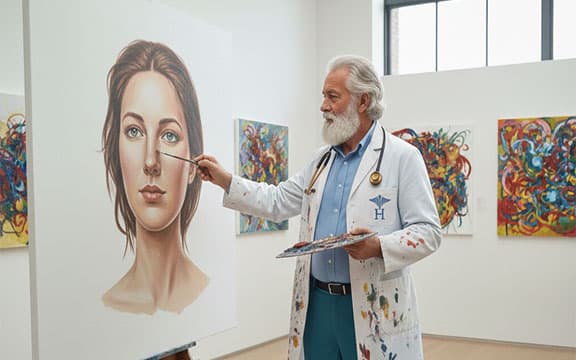
It is a discipline much like that of an artist. Imagine a painter who studies the expression on a person’s face, picks up his brush, and begins to create. He draws a few lines on canvas, and suddenly a likeness emerges. Is this a scientific process? Of, course not—it is art.
Similarly, consider the flute. How does it produce harmonious sound, weaving together ragas and melodies? This is not mere mechanics; it is artistry. The work of a true Homoeopathic physician is much the same.
In the hands of such a doctor, Homoeopathic medicine comes alive. His prescriptions are not mechanical outputs from a computer or a repertory. Instead, they arise from deep perception, refined intuition, and the power of analysis. Such a physician is rightly called an Artistic Prescriber.
How to use Repertory (Reference of the sec. 153 in the Organo of medicine.)
In the introductory chapter of his large repertory, under the section How to Use the Repertory, Dr. Kent emphasized the importance of Singular, Rare, Uncommon, and Peculiar (SRP) symptoms. He explained that the repertory can be used in two distinct ways: mechanically and artistically.
- Mechanical Use (Scientific Method): This involves collecting all the patient’s symptoms, listing the associated medicines with their gradings, and then preparing a summary. The prescription is made according to the grades marked at the end. Such use of the repertory is called mechanical or, more precisely, scientific.
- The Role of SRP Symptoms: Dr. Kent admitted that if SRP symptoms are neglected during this process, the mechanical use of the repertory becomes ineffective. He stressed that SRPs must be included for accurate and meaningful results. Thus, while the repertory provides a scientific framework, its true value emerges only when the physician recognizes and integrates the peculiar, uncommon symptoms that define the individuality of the case
The Art Beyond the Repertory
From Dr. Kent’s explanation, it becomes clear that without the art of Homoeopathic medical science, the mechanical use of the repertory has little value. A repertory, no matter how vast or detailed, is ultimately a useless tool if one does not know how to use it with insight.
The mechanical or scientific method—merely listing symptoms, grading medicines, and prescribing accordingly—cannot succeed unless it is guided by perception, intuition, and the recognition of Singular, Rare, Uncommon, and Peculiar (SRP) symptoms. Without this artistic dimension, the repertory becomes an empty exercise.
Thus, the repertory is not an end in itself, but a means. It's true power lies in the hands of a physician who combines science with art, transforming mechanical data into living prescriptions.
The Artistic prescriber
Conclusion:
From the above discussion, it becomes evident that true Homoeopathic practice extends far beyond a mere symptomatic approach or the mechanical use of the repertory. What is required is the physician’s power of perception and analysis, enabling him to grasp the true image of sickness.
It is only through thorough and continuous study of the Materia Medica that an ordinary prescriber can be transformed into an artistic physician. The repertory, while valuable, is not sufficient on its own; it must be guided by insight, intuition, and the ability to recognize the peculiar individuality of each case.
Thus, Homoeopathy is not simply a science of symptoms—it is an art of understanding the patient in his wholeness and prescribing with wisdom born of deep study and refined perception (As mentioned in Aphorism-3 and 7 in the organon of medicine.)