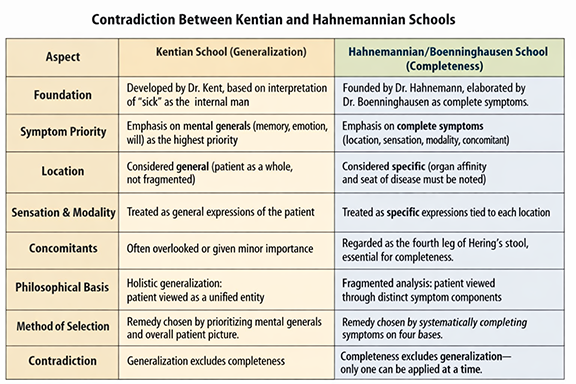
Kent's approach: In the present era, the most famous and widely adopted approach is Dr. Kent’s. This approach arises from a misunderstanding of the word “sick” mentioned in Aphorism 1 of the Organon of Medicine, where Dr. Hahnemann writes: “The physician’s high and only mission is to restore the sick.”
Dr. Kent interpreted this word as referring to the internal man—the patient himself apart from the physical body. From this interpretation, the concept of General Symptoms was born. According to this theory, symptoms that belong to the patient as a whole, or represent the inner man, are given priority in homoeopathic case taking.
In simple language, statements in which the patient uses words like “I” or “my”—expressions that represent the patient himself rather than his or her body parts—should be given the highest priority.
Hahnemann's approach: This approach originally given by Dr. Hahnemann latter promoted by Dr. Boenninghausen. these are two different approaches follow two different Philosophy. guideline regarding case taking is widely dispersed in the Organon of medicine but if we carefully study the Aphorims 153$, we clearly understant the extract of case taking according to Dr. Hahnemann.
in Aphorism 153$ Dr. Hahnemann states that:
Aphorism $153
" In this search for a homoeopathic specific remedy, that is to say, in this comparison of the collective symptoms of the natural disease with the list of symptoms of known medicines, in order to find among these an artificial morbific agent corresponding by similarity to the disease to be cured, the more striking, singular, uncommon and peculiar (Characteristic) Signs and symptoms of the case of disease are chiefly and most solely to be kept in view; for it is more particularly these that very similar ones in the list of symptoms of the selected medicine must correspond to, in order to constitute it the most suitable for effecting the cure. The more general and undefined symptoms: loss of appetite, headache, debility, restless sleep, discomfort, and so forth, demand but little attention when of that vague and indefinite character, if they cannot be more accurately described as symptoms of such a general nature are observed in almost every disease and from almost every drugs."
The underlined statement from Aphorism §153 is particularly noteworthy. In it, Dr. Hahnemann mentions symptoms such as loss of appetite, debility, restless sleep, and general discomfort. According to Dr. Kent, these are general symptoms that belong to the patient as a whole, rather than to specific parts of the body, and therefore hold primary importance in the selection of a homoeopathic remedy.
However, as the underlined passage of the aphorism makes clear, Dr. Hahnemann explicitly states that such ill‑defined, vague, and broadly general symptoms deserve little attention. Consequently, they carry very little weight in determining the appropriate homoeopathic medicine.
From the foregoing statement, it becomes evident that two distinct schools of thought exist within the realm of homoeopathy: the Kantian school and the Hahnemannian school. In the present era, the Kantian school has gained greater popularity, largely because its concepts are more easily understood and readily applied in clinical practice.
However, this approach diverges from the original intent of our Master, Dr. Hahnemann. It arose from a misunderstanding and misinterpretation of the term “sick” as used in the very first aphorism of the Organon of Medicine. Whereas Hahnemann employed the word in its true sense, referring to the diseased state to be restored, Kent’s interpretation shifted the meaning toward the “internal man,” thereby giving rise to a different philosophical orientation.
These two schools of thought are like opposite sides of the same coin: the promotion of one inevitably diminishes and distorts the other
The school was proposed by Dr. Kent himself, apart from the original Hahnemannian teaching, and it came into being because of a misinterpretation of the term “sick.” This school has its own philosophy, its own method of analysis, its own interpretation of symptoms, and its own procedure of case taking.
1. Philosophy: The Philosophy of Generalization
According to Dr. J.T. Kent, the term “sick” carries the meaning of the internal man—the patient as a whole. Therefore, he emphasized that “the symptoms which belong to the patient as a whole, hold the greatest importance in the selection of medicine.”
Building upon this idea, Kent developed his theory of generalization, classifying symptoms into two broad categories:
1. Physical general: Physical symptoms that belongs to the material body as a whole
2. Mental general: Mental symptoms that belongs to the meta-physical body belongs to the sole of internal man as a whole.
Within the mental generals, he further distinguished symptoms related to:
1. Memory: like forgetfulness.
2. Emotion: like sad, happy, jealous etc.
3. Will: Symptoms in which patient indicate that he/she will do something, or do not want to do something.
Case-taking procedure: While interacting with the patient, the physician must endeavor to collect all symptoms and qualify them with their exact sensation and modality. The location of symptoms is of lesser importance, since the patient is considered as a whole. Thus, location is regarded as general, and sensation and modality are likewise interpreted as general—because the prescription is ultimately made for the patient as a whole, not for isolated parts.
Analysis of the Symptoms: All collected symptoms should be analyzed thoroughly. The first priority is given to mental general symptoms, particularly those related to the will, followed by those concerning emotion and memory. Physical general symptoms hold the second priority. Symptoms belonging to particular parts of the body may also be considered, provided they qualify as characteristic symptoms—that is, when they present with a distinct sensation and a clear modality.
Remedy Selection: A remedy can be selected through systematic repertorization, either by using a computer repertory (new method) or a repertory sheet (old method). All symptoms are arranged according to their assigned priority, and the medicine that covers the maximum number of symptoms and achieves the highest score is considered the indicated remedy for the particular case.
This method of repertorization is entirely mechanical; it involves no art, only science. Any physician can acquire it through instruction, as it requires no special power of perception. Hence, it is termed mechanical repertorization.
Note: However, in the introductory chapter of Kent’s Repertory, Dr. Kent himself acknowledged that without the incorporation of S.R.P. symptoms, the mechanical use of the repertory becomes ineffective.
The concept was founded by Dr. Hahnemann himself, though he did not elaborate upon it. Later, Dr. Boenninghausen advanced and formalized the idea, presenting it as the theory of complete symptoms. According to this concept, the human entity must be considered in a fragmented manner, with each symptom analyzed through its essential components—location, sensation, modality, and concomitants—to achieve completeness in case analysis.
Philosophy: The philosophy of complete symptoms.
It is essential for every physician engaged in the art of healing to strive to complete each symptom on the basis of the four fundamental elements: location, sensation, modality, and concomitants.
Elaboration of the concept: Dr. Hahnemann theory of Singular, Rare, uncommon, peculiar (SRP) symptoms is somewhere hidden in the concept of Complete symptoms. it is not merely a mechanical concept but a Dynamic one. if are able to solve the mystery of location, sensation, modality, and concomitant perhaps, we can understand it.
1. Location: indicates the organ affinity of a drug. Every medicine has a natural tendency to act upon a particular organ or system of the body, which becomes the seat of disease. By disturbing the vital energy of that organ, the drug produces characteristic symptoms. Thus, identifying the location helps in understanding the sphere of action of the remedy and its therapeutic relevance. (Base of Organopathy)
1. Sensation:
The sensation that emerges from an organ depends upon the specific type of derangement occurring in the vital energy of that organ. In other words, the nature of the disturbance in vitality determines the quality of the sensation experienced and expressed as a symptom.
3. Modality:
Modality refers to the aggravating and ameliorating factors that depend entirely on the direction of the derangement of vital energy. If the disturbance occurs in a negative direction, the organ tends to become chilly, and its complaints are aggravated by cold. Conversely, if the derangement occurs in a positive direction, the organ becomes heated, and the complaints are aggravated by warmth. Other types of modalities are essentially modifying forms of this fundamental thermal modality, which serves as the primary guide in understanding the conditions under which symptoms intensify or improve.
4. Concomitants: are the peculiar, often mysterious symptoms that accompany the main complaint. They must be regarded as the fourth leg of Hering’s stool in his tripod stand theory. According to Dr. C. Hering, it is the duty of every physician to complete the symptom picture on all four legs—location, sensation, modality, and concomitant. If this is not possible, then at the very least, the prescription should be based on three legs: location, sensation, and modality.
Every location has its own specific concomitant weather you know or don't know. these phenomena can be easily explained basis on the energy channel theory used in the Acupressure and puncture treatment. accordance to this theory or concepts our vital energy flows in particular channel they are numerous in human body, some are different in male and female. two types of energy are flows in them. known as negative and positive energy, dominancy decides hot or chilly nature of the patient. here it is to be consider that the total energy of a person is constant but differ from another person. energy level of same age group in male and female also different. when this derangement occurs, some parts of the body become hot other becomes cold, hence the appearance of the concomitant symptoms is the rule.
so, concomitant symptoms can be defined, "concomitant is the symptoms that occur with basic derangement of the vital force, has no physiological or pathological relation with basic derangement but dynamic one".
Case taking procedure: Count the affected locations and record each one separately. For every location, note the specific sensation individually, and then identify the clear modality associated with it. Whenever possible, also search for concomitant symptoms, as these complete the symptom picture and enrich the analysis.
Analysis of the symptoms:The first priority must be given to complete symptoms. When the mind is the prime location, it enhances the significance and power of these complete symptoms; thus, the mind should be considered the primary location. Complete symptoms belonging to the physical body are secondary in importance. Ill‑defined or incomplete symptoms hold no value in the selection of medicine.
According to this theory of remedy selection, there is no such existence as a general location, general modality, or general sensation. This argument demonstrates that the two approaches are fundamentally contradictory. At any given time, only one theory can be applied; if one is adopted, the other is automatically excluded.
The two theories stand in direct contradiction to one another; only one can be applied at a time, and the adoption of one necessarily excludes the other. It ultimately depends upon the physician to decide which approach to employ. If Kent’s method is chosen, the omission of strange, rare, and peculiar (SRP) symptoms becomes the guiding rule. Conversely, if the theory of complete symptoms is followed, the concept of a “general location” has no place. In practical terms, not a single medicine in the entire Materia Medica can be classified as inherently “chilly” or “hot”—and the same statement holds true for patients themselves.