Correct Use of the Repertory: Reference Tool or Systematic Repertorization in the Spirit of Hahnemann.
The Repertory is not a substitute for the physician’s judgment but a supportive reference tool. Its purpose is to assist in recalling remedies and guiding the practitioner toward possible choices, never to dictate them. Hahnemann emphasized that the physician must always return to the totality of symptoms and the Materia Medica for final confirmation.
Systematic repertorization provides a structured way to analyze symptoms, yet it must remain flexible and subordinate to the principle of individualization. The true spirit of Hahnemann lies in using the Repertory as a map—helpful for orientation but never replacing the physician’s direct observation and reasoning.
In the present era, it has become common practice for homeopathic doctors to rely heavily on the repertory for prescribing medicines. The artistic and individualized approach to prescription seems to have been lost along the way. Today, the repertory is often treated as the prime—and sometimes the only—tool for selecting a remedy. This approach is highly formal and mechanical, often applied without a deeper understanding of the background and philosophy of the repertory itself. The process typically involves collecting all the patient’s symptoms, entering them into a computerized repertory, and then selecting the medicine that covers the greatest number of symptoms and ranks highest. This medicine is then considered the Similimum.
I am sorry to say, but this is not the proper way to use the repertory. If you refer to Kent’s Repertory of the Homoeopathic Materia Medica, in the introductory chapter under “How to Use the Repertory,” Dr. Kent clearly states that without including the singular, rare, uncommon, and peculiar symptoms in the totality, the aggregate of symptoms is useless. He cautions that such an approach amounts tomechanical repertorization, which strips the process of its true value and artistry. Hence, the successful use of the science of repertory requires a true application of the principles of homoeopathy. The repertory is not an end in itself, but a means to guide the physician toward the Similimum. Its proper use demands a philosophical understanding of homoeopathy, careful attention to the peculiar and characteristic symptoms, and the art of individualization. Without this foundation, repertorization becomes mechanical and loses its true purpose; with it, the repertory becomes a powerful instrument in the hands of a thoughtful practitioner.
Repertory Definition and uses:
The intelligent use of a repertory implies that we understand the scope of a repertory as well as the purpose of a repertory, we may ask, what is the repertory? to which the reply might be: " A repertory is an index of symptoms, arranged systematically." Again, we may ask: " What is the purpose of Repertory?" our answer may be, A repertory has two definite purposes.
1. To serve as a reference and guide in looking up a particular symptom.
2. For careful study of all the symptoms that may appear in a chronic case.
Where to use Repertory:
The repertory is not intended for use in cases where there are clear indications for the Similimum. As Dr. Boenninghausen himself stated, the repertory is not the prime tool for the selection of medicine, but rather a supportive aid in the hands of a skilled physician. It's true purpose is to assist when the choice of remedy is uncertain, guiding the practitioner toward the right direction—never to replace the physician’s judgment or the principles of homoeopathy.
According to Dr. Boenninghausen, the best use of the repertory is for reference purposes—that is, to identify the specific symptoms which constitute, or help to constitute, the totality of symptoms. Another important use of the repertory is to distinguish the differences between remedies that may appear equally indicated in a particular case. In this way, the repertory serves as a guide to sharpen the physician’s judgment, rather than as a mechanical tool for prescription.
Scope and limitation of Repertory:
Have a Question?
Ask HomeoEra Journal Editorial Team about "Correct Use of the Repertory: Reference Tool or Systematic Repertorization in the Spirit of Hahnemann." and get a personalized response directly to your email.
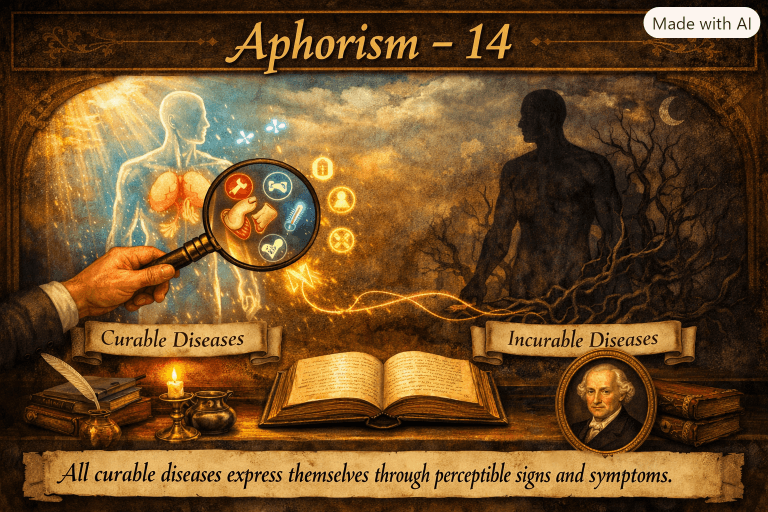
In this aphorism, Dr. Samuel Hahnemann elucidates a fundamental law of observation in medicine: that every curable disorder within the human organism necessarily reveals itself through perceptible signs and symptoms. Nothing curable remains hidden from the discerning physician, for the divine order has ordained that disease must express its presence outwardly to invite cure.
Thus, the physician’s art depends entirely upon the faithful interpretation of these manifestations. The morbid phenomena are not mere disturbances but the visible language of Nature, guiding the healer toward restoration. Those affections that grow silently within, without perceptible symptoms, belong to the realm of the incurable; for where no sign is given, no curative response can be awakened.
In essence, Hahnemann reminds us that symptoms are the thread of cure—the only bridge between the inner disorder and the physician’s understanding. To grasp that thread is to hold the possibility of healing; to lose it is to stand before disease without remedy.
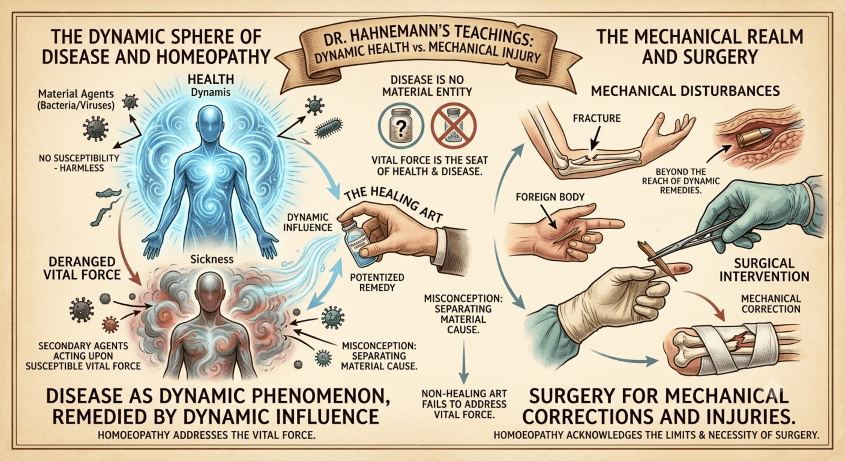
The doctrine of Homoeopathy is inseparably bound with the principle of dynamism. It does not aim at repairing the material body in isolation, but rather seeks to restore the vital force—the dynamic essence that animates life. Disease, in this philosophy, is not merely a structural defect or chemical imbalance; it is a disturbance on the dynamic plane, a disharmony of the spirit‑like energy that governs sensation and function.
Homoeopathic medicine, therefore, is not material in its curative action. Prepared through potentization, it transcends crude substance and becomes a dynamic remedy, capable of resonating with the disturbed vital force. Cure is achieved not by suppressing symptoms or altering tissues directly, but by stimulating the inner harmony, allowing the body to reorganize itself from within outward.
Thus, the true aim of Homoeopathy is not to treat the corporeal frame, but to re‑establish balance in the living dynamis, from which health naturally flows into the material body.
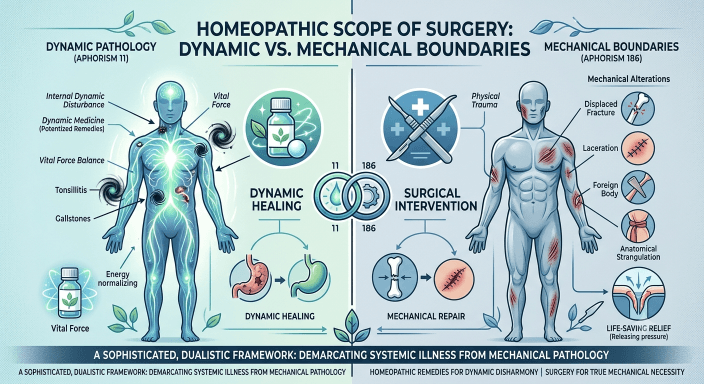
Surgery represents one of the most decisive acts in medical practice—an intervention that seeks immediate relief by removing or altering diseased tissue. Yet, within the philosophy of homoeopathy, surgery is not regarded as a primary mode of cure but rather as a necessary measure when the natural laws of healing cannot be invoked. Homoeopathy emphasizes restoration through the vital force, aiming to correct internal imbalance rather than mechanically excising its manifestations.
The scope of surgery in homoeopathy lies in emergencies, irreparable structural damage, or conditions where mechanical obstruction threatens life. Its limitations, however, are evident when surgery is employed as a substitute for true cure, ignoring the deeper dynamic disturbance that gave rise to pathology. Thus, surgery may save life or prevent immediate danger,
but it cannot address the underlying susceptibility that homoeopathy seeks to harmonize.
In this way, surgery and homoeopathy are not adversaries but complementary disciplines. Surgery provides mechanical aid where necessary, while homoeopathy ensures the restoration of health by addressing the vital force. The ethical challenge lies in discerning when surgical intervention is indispensable and when reliance on the body’s healing potential, guided by homoeopathic remedies, is sufficient.
Disease is not a material thing lodged in the body but a dynamic disturbance of the vital force, the invisible principle that sustains life. When this vital force is in harmony, health prevails; when disturbed, it manifests as altered sensations and functions that we call disease. Thus, disease is not a foreign substance but an immaterial imbalance, and cure lies in restoring the vital force to its natural equilibrium.