
Phosphorus as a Remedy in Tongue Cancer: A Case Study
The healing power of Homoeopathic medicines in cancer is a challenging subject. Cancer is one of the most difficult conditions to treat, yet in some cases, remedies have shown clear benefit. This case of tongue cancer responded in a remarkable way to Phosphorus 1M, given in a single dose. Dr. Samuel Hahnemann taught that a physician should never be judgmental or make assumptions about the outcome. Our duty is not to speculate, but to carefully observe how the remedy acts. In this case, Phosphorus showed its specific effect very clearly. After one dose of Phosphorus 1M, the cancerous growth burst open, giving great relief to the patient. The most important change was that the patient, who had been unable to open the mouth because of the growth, was now able to do so. This improvement brought both physical comfort and emotional relief. Such cases remind us that the physician’s role is to apply the law of similars with care and patience, allowing the remedy to show its natural action. The effect of Phosphorus here is a strong example of the lasting truth of Hahnemann’s principles.
Habib khan
Deals with Chronic diseases
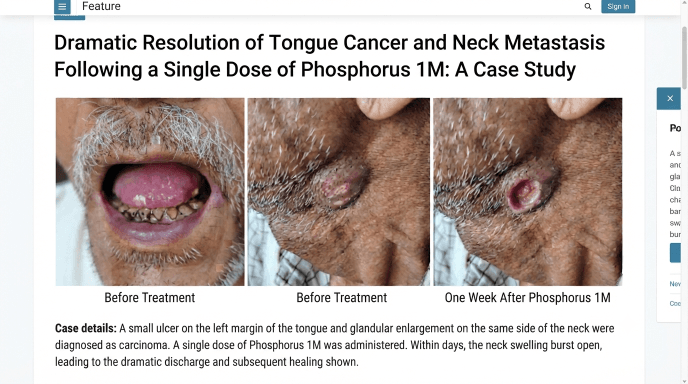
This is a case of tongue cancer, diagnosed on the basis of symptomatology. A biopsy was not performed.
A 70-year-old male patient presented at the clinic with the following complaints: 1. Tongue lesion – A small, white-colored ulcer located on the left margin of the tongue, associated with symptoms of tongue-tie (restricted tongue movement). 2. Neck growth – A large nodular swelling on the same side of the neck, without any signs of abscess formation and notably painless
1st prescription - Phosphorus - 1M (Single dose)
1st follow up - (Date 28/06/2026) 1.The cancerous growth on the left side of the neck burst within three days of the administration of Phosphorus 1M.
Case reception:
I received this case on 22/06/2026. The patient visited my morning clinic, seeking hope in Homoeopathy after refusing both biopsy and Allopathic treatment.
Previously, he had consulted an oncologist, who advised a biopsy before starting any treatment. The patient, however, declined the procedure and chose to consult me instead.
Clinical presentation of the case:
Other complaints:
Medical history:
1. The patient had a strong desire to drink cold water, especially icy or freezing water. However, each time he drank it, he developed coryza (running nose) and dyspnoea (difficulty in breathing). The craving for cold water was intense, yet it always left him feeling worse, with sneezing, nasal discharge, and shortness of breath
2. At present, the patient has no complaints related to cold. These symptoms disappeared after the development of the cancerous ulcer on the left side of the tongue and the associated glandular swelling.
Generalities:
Live follow up:
Comments (0)
No comments yet. Be the first to share your thoughts!