
Totality of Symptoms: From Mystery to Meaning.
The “totality of symptoms” remains a term shrouded in mystery—difficult to define and even more difficult to apply in practice. What, in fact, constitutes the totality of symptoms? The question is still unresolved. Though many stalwarts of homeopathy have offered their interpretations, none has yet provided a view that is universally accepted, consistent, and fully intelligible. One truth must be emphasized: merely assembling a group of symptoms collected from the patient through head‑to‑foot investigation does not constitute the true totality of symptoms. In order to resolve this enigma, many homeopathic physicians have made earnest efforts and contributed their perspectives. The theory of the evolution and classification of symptoms was the very first attempt to achieve clarity in defining the totality of symptoms.
Admin User
An overview:
Stallwart's view:
Logical question:
A very logical question arises here, Are Boenninghausen’s concept of complete symptoms and Dr. Hahnemann’s concept of SRP (strange, rare, peculiar) symptoms two distinct approaches that exclude the totality of symptoms? or is the SRP implicitly embedded within the theory of complete symptoms?
The correct understanding is the latter. Dr. Hahnemann’s SRP symptoms are indeed present within Boenninghausen’s theory of complete symptoms, though not always visible at first glance. They exist in the structure just as:
1. Butter is hidden within milk, awaiting extraction,
2. or as value is concealed within a mathematical formula, only revealed when the equation is solved.
In the same way, SRPs are not separate from the complete symptom framework; rather, they are latent gems that emerge when the physician carefully analyzes the symptom in its four essential dimensions—location, sensation, modality, and concomitants. The SRP shines forth as the peculiar essence of the case, but it is inseparably woven into the completeness of the symptom.
Thus, the theory of complete symptoms and the concept of SRP (strange, rare, peculiar) symptoms are not two separate or contradictory approaches. Rather, they represent different expressions of the same principle in relation to the totality of symptoms. The SRP is not external to Boenninghausen’s framework; it is inherently embedded within the completeness of the symptom.
Water analogy theory of Totality of the symptoms: (Proposed by Dr. Habib khan)
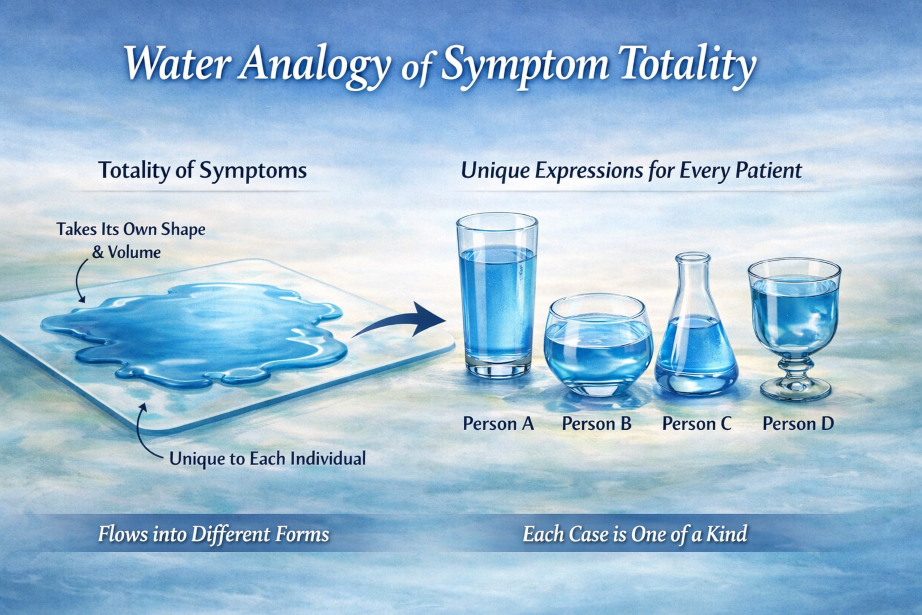
If I were allowed to express my view regarding the totality of symptoms, I would illustrate it through a water analogy theory. In this theory:
* The container (vessel) represents the material body.
* The water inside symbolizes the vital force.
* Pouring water onto a glass surface is like the dynamic cause, which gives vibration to vitality.
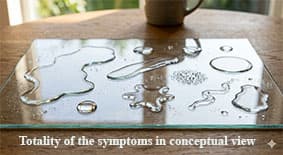
As water spreads across the surface, it always assumes different shapes and volumes—just as disease manifests uniquely in each individual. This analogy clearly illustrates the concept of individualization and the essence of SRP (strange, rare, peculiar) symptoms.
Here, the water spreading across the glass surface is always single in origin, yet peculiar in shape and individualized (rare) in manner. In the same way, each patient’s symptom-picture arises from one vital disturbance but expresses itself in a distinctive, uncommon form that defines the true individuality of the case. Another very important question arises here: What should be our case‑taking format? The answer rests upon a philosophical foundation. Indeed, the blank paper remains the best format for case taking. because it allows fluidity without restrictions. (Leading question) Thus, disease may be conceived as a kind of volumetric geometry—it always assumes the shape of its container. When case taking is forced into a predetermined format, the disease is given an artificial shape, and its true nature remains concealed. that's why Dr. Hahnemann instruct us do not ask leading question during case taking.
Justification of single remedy practice:
Other stalwart's view regarding totality of symptoms:
Conclusion:
It may thus be concluded that the totality of symptoms constitutes the true portrait of the disease. At present, this remains entirely a matter of perception, for we possess no medical instrument capable of measuring the deranged vital force or calculating it in any definable unit.
The physician’s insight alone bridges this gap, discerning the dynamic disturbance through the constellation of symptoms, which serve as the only accessible reflection of the inner essence of disease.
About Admin User
HomeoEra: A Global Platform for Doctors Our mission is to build the largest database of homoeopathic knowledge for future generations. With a special focus on teaching Materia Medica and the Organon of Medicine, we aim to strengthen the foundation of classical homoeopathy worldwide. We invite you to share your cured cases on this platform, contribute to collective learning, and support fellow practitioners. Together, let us take a decisive step toward establishing world-class homoeopathy. Join hands with HomeoEra—where knowledge meets cure.
Comments (0)
No comments yet. Be the first to share your thoughts!