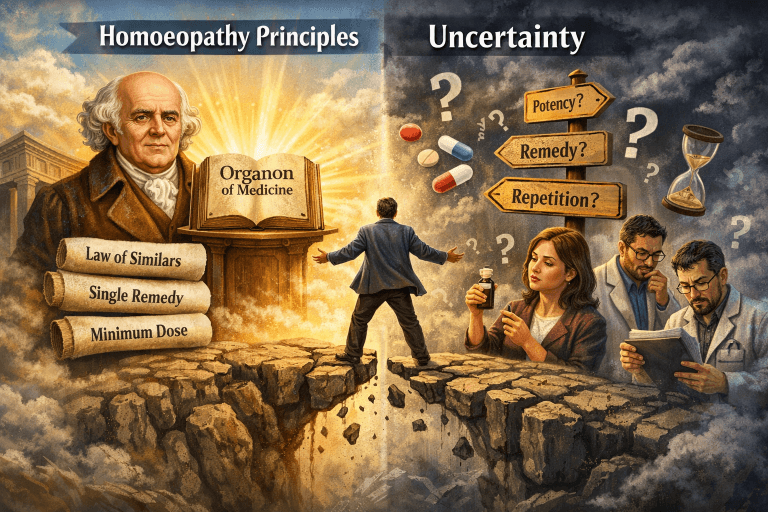
Undoubtedly, practicing allopathy during the time of Dr. Hahnemann was quite different from the present era. Procedures such as drug proving did not exist at that time. The practice of medicine was entirely clinical and experience based. In such circumstances, Dr. Hahnemann developed and established a system of treatment that was fully founded upon principles known today as the cardinal principles of Homoeopathy. In this system, assumption was completely eradicated; everything was fixed and guided by rule. Yet, followers of this great system, founded by our master, often appear confused. They encounter uncertainty at every step—whether in the selection of medicine, the choice of potency, the proper repetition of doses, or in the application of complementary and chronic remedies. Even today, many practitioners still struggle to understand how these principles should be applied in practice.
The big question that arises here is: Why are the followers of Hahnemann so confused, even though Homoeopathy was founded upon strict principles and its practice is fully guided by the Organon of Medicine? Despite this clear foundation, practitioners often struggle with uncertainties in remedy selection, potency choice, dose repetition, and the proper use of complementary and chronic medicines.
The answer is simple: confusion arises not from the principles themselves, but from the imperfect understanding and inconsistent application of those principles. The Organon provides clarity, but practitioners often misinterpret its guidance, neglect its depth, or fail to adapt it to the complexities of modern cases. Thus, uncertainty is not inherent in Homoeopathy—it is born of human limitation in grasping and applying its laws. that's why, all followers of Dr. Hahnemann are not of the same mind, even though they have simple guidance before them.
Case taking and selection of medicine: Case taking is the first and most essential step in the practice of Homoeopathy, yet it demands broad and comprehensive knowledge. It is not merely the mechanical recording of symptoms, but a deep process of perceiving the patient’s individuality, understanding modalities, and grasping the finer shades of sensation and expression. Without a thorough and skillful case taking, the selection of the appropriate remedy becomes uncertain, and the very foundation of Homoeopathic practice is weakened.
Without proper understanding the procedure of case taking; the selection of right remedy becomes impossible. When attempting to take a case, the physician must first decide which method to adopt.
At the very outset, you need to decide whether you are a student of the Kentian school or a follower of Hahnemann. This choice is fundamental, because the method of case taking, the interpretation of symptoms, and the philosophy of prescription differ greatly between the two. The Kentian school emphasizes analysis through hierarchy of symptoms, often giving priority to mental and emotional features, while the Hahnemannian approach—rooted in the Organon—insists upon the complete symptom, including location, sensation, modalities, and concomitants. Without clarity on which school you follow, uncertainty will inevitably arise in remedy selection and clinical practice. we have two methods anyone can be adopt by student.
1. Complete symptoms theory - Promulgated by Dr. Hahnemann & latter followed by Dr. Boenninghausen.
2. General symptoms Theory - Promulgated by Dr. Kent.
It often appears that most students are unable to distinguish the differences between these two theories, and as a result, they frequently mix them. This blending of approaches leads to confusion in case taking, remedy selection, and overall practice, since the Kantian and Hahnemannian schools are founded upon fundamentally different principles that cannot be applied simultaneously.
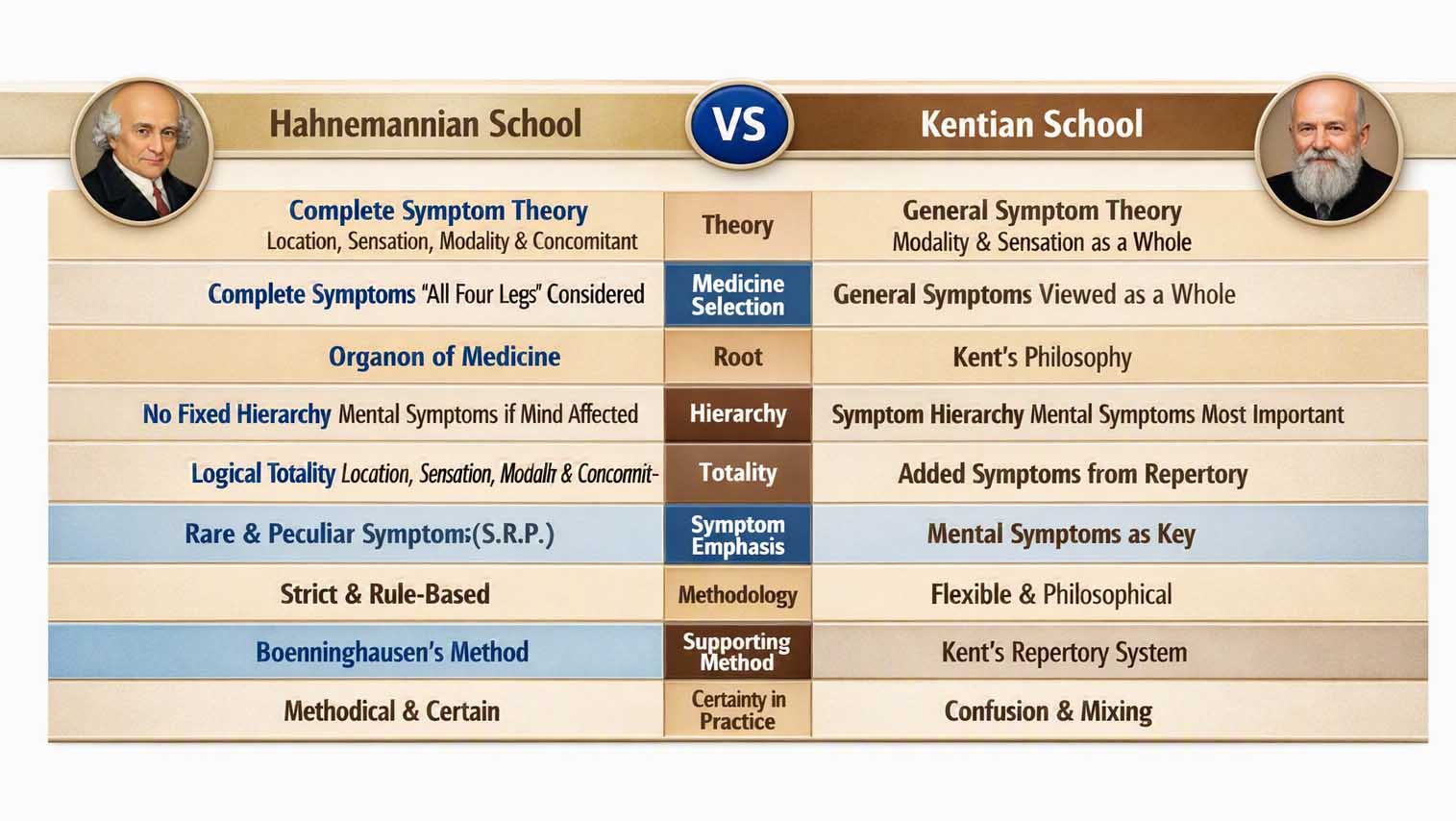
From the above discussion, it is evident that the Hahnemannian system is comparatively more stable and exhibits less uncertainty than the Kentian system of medical practice. By adhering to the Hahnemannian school, one can effectively minimize uncertainty in clinical application; just because Hahnemannian approach is practical one and maintain the integrity of SRP symptoms. statement can be verified upon the following point.
1. General modality: The notion of a ‘general modality’ does not exist. Modalities are always specific, defined by the precise conditions under which symptoms are aggravated or ameliorated. To treat them as general abstractions would contradict the principle of complete symptomatology, where location, sensation, modality, and concomitant must be considered in their concrete, individualized form.
2. General sensation: Rarely found or more often associated with skin complaints otherwise different location shows different sensation like fear of death always associated with heart disease, sadness or melancholia accompanied with liver complaints and frequent urination is aligned with urinary bladder. evidently clear that different organ shows different sensation.
3. Concomitant - Concomitants are highly specific, strongly aligned with precise location, it makes fourth legs of Hering's stool. " The often‑repeated claim in college that “everything remaining after the collection of location, sensation, and modality is concomitant” is fundamentally flawed. Such a statement reduces the doctrine of complete symptoms to a simplistic residue and is, in truth, nothing more than intellectual nonsense. here are giving some examples of complete symptoms and now you decide what is concomitant?
1. Vertigo, lying on his back with weakness in pit of stomach (Alumen,)
2. Non coaguble bleeding from the nose, with the sensation of tightness across the bridge of the
nose, (Hamamelis, Ruta)
3. heart palpitation worse by least motion associated with uterine or ovarian complaint (cimicifuga)
4. Skin urticaria worse during cold damp weather and after cosmetic cream with absent mind (Bovista)
6. Uterus pain with bearing down sensation < slightly touch complaint associated with hot sweat (Tilia europoea)
The concomitant is intimately connected with a specific location. In fact, every location carries its own concomitant—whether recognized by the physician or not. These accompanying manifestations enrich the completeness of the symptom picture and must be considered in case analysis, as they inseparably belong to the location itself.
1. One cannot be certain about the rules upon which medicine must be selected.
2. Improper and insufficient understating of the Organon of medicine
3. Improper selection of dose and its repetition.
4.
Not letting the medicine take its own time to perform its efficient action.
Although the practice of Homoeopathy is fully guided by the Organon of Medicine, uncertainty undeniably persists within the system. The rules are clear, yet different minds select different medicines, and no one can say with certainty which choice is correct. In effect, every physician seems to have their own Organon: one selects remedies based on mental symptoms, another prioritizes constitutional factors, while a third gives precedence to emotional or psychological states. This divergence in interpretation and application creates a landscape of variability, despite the existence of a common guiding text.
If I had cured a case of biliary obstruction with Pulsatilla, I could not assert with certainty that another case of the same disease would be cured by the same medicine. This illustrates the inherent complexity of the Homoeopathic system—yet it is a natural consequence of its principles. Despite the guidance of the Organon, the divergence of individual minds in remedy selection makes our system increasingly intricate, and the sense of uncertainty grows with each passing day.