
Causa Occasionalis: The Distinct Cause Beyond Exciting, Maintaining, and Fundamental cause.
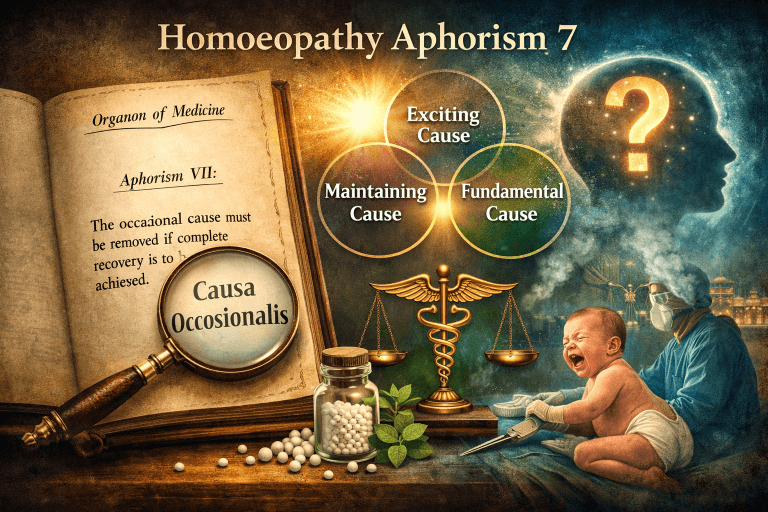
Homoeopathy is often viewed as a system based solely on symptoms, yet Aphorism 7 of the Organon of Medicine reveals a deeper truth. Cure cannot be achieved without addressing the underlying cause—whether exciting, maintaining, or fundamental. Beyond these, Hahnemann introduces the concept of Causa Occasionalis, an occasional or external factor that obstructs recovery unless removed. From foreign bodies and congenital deformities to occupational irritants, these causes highlight the essential role of surgical or corrective measures alongside homoeopathic treatment. Aphorism 7 thus broadens the scope of practice, reminding physicians that lasting cure demands more than symptomatic prescription—it requires eliminating the true obstacle to healing.
Admin User
Acceptance of Surgery in Homoeopathy: Insights from Aphorism 7
Introduction:
Homoeopathy is often described as a system that works primarily with a symptomatic approach. Yet, this is not universally true. A thorough study of Aphorism 7 in Hahnemann’s Organon of Medicine reveals that symptoms alone do not always dictate the prescription. If homoeopathic medicine must always be prescribed according to symptoms, then what role do causes—whether exciting, maintaining, or fundamental—play in treatment?
The answer lies in a deeper understanding of Causa Occasionalis, a concept that expands the scope of homoeopathic philosophy and clinical practice.
What is Causa Occasionalis?
Causa Occasionalis refers to an occasional or external cause that obstructs cure unless it is removed. Without addressing the basic cause, symptomatic treatment often remains ineffective. This principle applies to every type of cause:
Exciting cause – triggers the onset of disease.
Maintaining cause – perpetuates the disease condition.
Fundamental cause – underlying predisposition or miasmatic influence.
However, Aphorism 7 emphasizes that it is not always necessary for a physician to remove the cause at the very first attempt. Instead, careful observation, time, and attention to the case are required. Importantly, Causa Occasionalis may be congenital or acquired, and its management often extends beyond medicine into surgical or lifestyle interventions.
Examples of Causa Occasionalis:
1. Foreign bodies in the eyes, larynx, or other parts of the body.
2. Strong‑smelling substances in the patient’s environment that may provoke syncope or hysterical symptoms.
3. Imperforate anus in newborn infants.
4. Splinters lodged at the fingertips.
5.Congenital deformities requiring surgical correction.
6. Occupational irritants that must be eliminated for lasting cure.
These examples highlight that unless the occasional cause is removed, homoeopathic remedies alone cannot achieve permanent recovery.
Aphorism 7 and Surgical Scope:
The study of Aphorism 7 opens the door for recognizing the scope of surgical intervention within homoeopathy. Certain congenital causes—such as imperforate anus in infants or foreign bodies in the eyes or larynx—demand surgical correction. Without such intervention, symptomatic treatment offers no hope of cure.
Thus, Aphorism 7 bridges the gap between medical therapeutics and surgical necessity, reminding practitioners that homoeopathy does not exclude surgery but rather integrates it when required to remove the causa occasionalis.
Conclusion:
About Admin User
HomeoEra: A Global Platform for Doctors Our mission is to build the largest database of homoeopathic knowledge for future generations. With a special focus on teaching Materia Medica and the Organon of Medicine, we aim to strengthen the foundation of classical homoeopathy worldwide. We invite you to share your cured cases on this platform, contribute to collective learning, and support fellow practitioners. Together, let us take a decisive step toward establishing world-class homoeopathy. Join hands with HomeoEra—where knowledge meets cure.
Comments (1)
Symptoms have the deeper meaning, always symptoms doesn't mean symptom.